A wedding website builder gives your guests one link for the date, the venue, travel, the registry and the RSVP. Several wedding platforms, including The Knot and Joy, let you build and publish that site for free. The differences sit in the details: what the free tier leaves out, how you keep guest data private, what a custom domain costs and how long the site stays online.
This guide compares wedding website builders from their own pricing and help pages, checked on 20 October 2026. It covers wedding platforms (The Knot, Joy, Riley & Grey, WedSites and Appy Couple) and general website builders (Squarespace and Wix). listing.sh did not build test sites, so there are no scores or rankings. Prices are in US dollars (USD) as of October 2026, except where a vendor showed us another currency. Check each vendor page before you pay.
What a wedding website needs
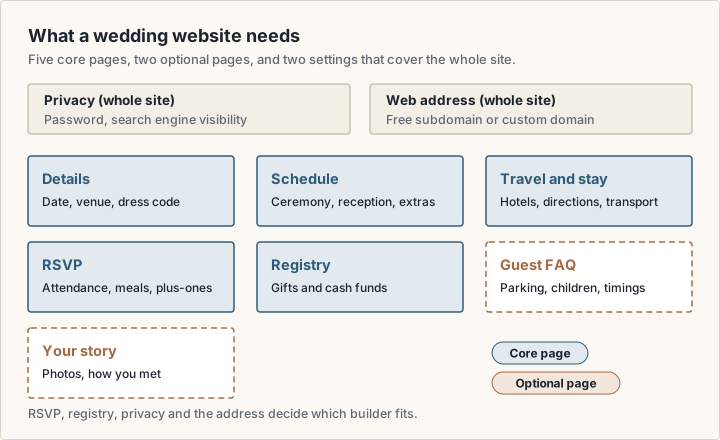
Before you compare builders, list what your site must do. For most couples the list is short, and four items decide which builder fits: RSVP, registry, guest privacy and the web address.
RSVP that feeds your guest list
Online RSVP is the feature that saves the most follow-up. On wedding platforms the RSVP form writes straight into a guest list. Joy's RSVP asks by default about attendance, meal preferences, hotel rooms, rehearsal attendance, mailing address and how the guest knows you (Joy (opens in a new tab)). The Knot collects RSVPs through the published website, and you choose whether anyone can respond or only guests on your list (The Knot Help Center (opens in a new tab)).
On a general builder you build the RSVP yourself. Squarespace suggests a form block connected to an email address, Google Drive or Mailchimp (Squarespace Help (opens in a new tab)). That works, but the responses land in a spreadsheet or inbox, not a guest list with plus-ones and meal counts. You can also embed a separate form tool such as Tally, but you still merge the answers into your guest list yourself.
Registry links or a built-in registry
The Knot, Joy, WedSites and Squarespace all let you link to registries at other stores, and The Knot and Joy also run their own. The Knot lets you link registries from several retailers and share one registry link with guests (The Knot Help Center (opens in a new tab)). Joy advertises zero-fee cash funds (Joy (opens in a new tab)). Squarespace offers a Zola block that shows up to 12 items from a Zola registry on your page (Squarespace Help (opens in a new tab)).
Guest privacy
A wedding site holds your names, the date, the venue and sometimes your home city. Decide early who should see it. The common controls are a site password, page-level passwords, events that only invited guests see, and a switch that hides the site from search engines. The privacy section below compares them.
A web address guests can type
Free plans publish on the platform's own address, such as a wixsite.com subdomain. A custom domain, such as your two names plus the year, is easier to print on a save-the-date. It costs extra on The Knot, Joy and Appy Couple, Riley & Grey bundles it into the membership, and each one renews on its own schedule.
Wedding platform or general website builder?
Search results for this keyword mix two kinds of tool. A wedding platform is built around the guest list: RSVP, plus-ones, meal choices, registry and guest messages work together. A general website builder, such as Squarespace or Wix, gives you more design freedom, but the wedding features are blocks and add-ons you assemble yourself.
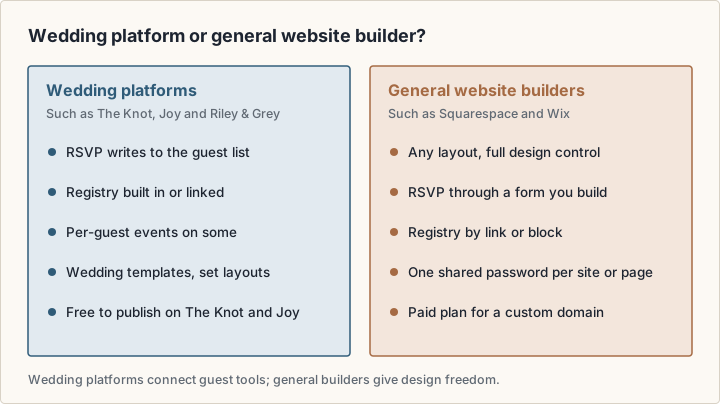
| Feature | Wedding platform | General website builder |
|---|---|---|
| RSVP | Built in, writes to the guest list | A form you build; answers go to email or a sheet |
| Registry | Built-in registry or linked registries | Links, image blocks or a registry block |
| Privacy | Site password; some hide events per guest | One password per site or page |
| Cost to publish | Free on The Knot and Joy; paid on others | Wix free with branding; Squarespace paid |
| Design | Wedding templates with set layouts | Any layout; more setup time |
| After the wedding | Depends on the platform's rules | Stays while you pay for the plan |
A general builder makes sense if one of you already pays for a site, or if the design matters more than guest tools. For anything else, a wedding platform needs less setup. If you are weighing design-first builders, our Framer vs Webflow comparison and the AI website builder comparison cover those tools in depth.
Wedding website builder options compared
Each entry lists the pricing model, what is free, the custom domain terms and the privacy controls the vendor documents. Facts come from each vendor's own pages; where we could not load a page, we say so.
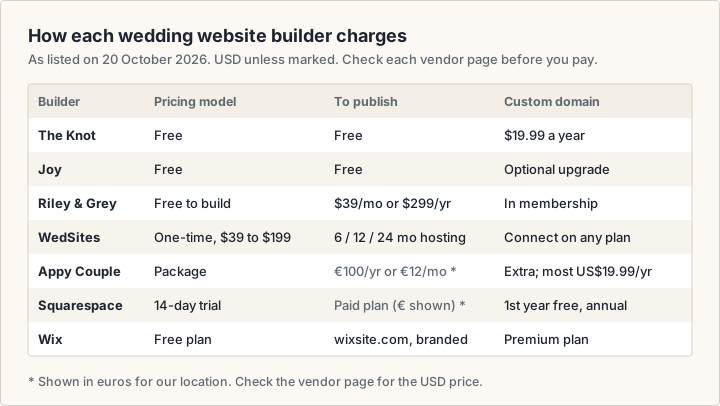
The Knot
The Knot's help center states that its wedding websites are "completely free to use", with no required fees, subscription or trial period. The free site includes templates, RSVP collection, registry integration, travel information, dress code and guest messaging. The one paid upgrade it names is a custom domain (The Knot Help Center (opens in a new tab)).
A custom domain costs $19.99 for one year or $39.98 for two years; a .wedding domain costs $99.99 a year. It does not renew automatically, so you renew it by hand in the 30 days before it expires. If it lapses, the site falls back to your free address (The Knot Help Center (opens in a new tab)). The Knot also notes that it is a US-based site, and some guests abroad may not be able to view the site, RSVP or buy gifts (The Knot Help Center (opens in a new tab)).
Joy
Joy's pricing page lists $0 a month for the planning dashboard, wedding website, registry, mobile app, unlimited guests, online RSVP and multiple editor accounts. Joy says it earns money when guests buy registry items that Joy sells, and from optional upgrades: custom domains, text messaging and premium stationery designs (Joy pricing (opens in a new tab)).
On privacy, Joy lets you password-protect specific pages or the whole site, control whether your event appears in search results, and show each guest only the events they are invited to. Guests get a companion app, and they need the app to upload photos to the shared album (Joy (opens in a new tab)).
Riley & Grey
Riley & Grey takes the opposite approach: no ads, and you pay to publish. Building is free with no time limit. Publishing costs $39 a month or $299 for a year, and a $39 Reserve plan holds your domain and design, with the $39 credited to a membership later. Prices are in USD (Riley & Grey pricing (opens in a new tab)).
The membership includes a custom domain, digital invitations and the registry. Cash funds carry a 2.95% transaction fee, paid by the guest or the couple. When you end the membership, Riley & Grey will transfer the domain to you on request (Riley & Grey pricing (opens in a new tab)). Its privacy controls include passwords, guest list matching and search result options (Riley & Grey (opens in a new tab)).
WedSites
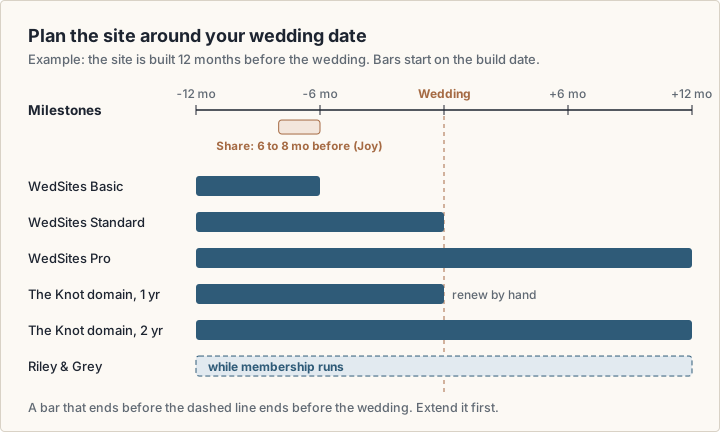
WedSites sells one-time plans, each with a fixed hosting period. Basic costs $39 with 6 months of hosting, Standard $99 with 12 months, and Pro $199 with 24 months. Extra hosting starts at $5 a month, paid yearly. All plans include a 14-day money-back guarantee, and you can start designing free (WedSites pricing (opens in a new tab)).
Read the tiers closely. Basic includes the builder, all themes, optional password protection, registry links and a custom domain connection, but online RSVP, the guest list and digital invitations start at Standard. Pro adds planning tools and a multilingual site (WedSites pricing (opens in a new tab)).
Appy Couple
Appy Couple sells one package that covers the website, a guest app and digital invites. The page we loaded showed €100 a year or €12 a month, which likely reflects our location, so check the USD price on the Appy Couple pricing page (opens in a new tab). The same page says custom domains cost extra, and that most cost US$19.99 a year.
Squarespace
Squarespace has no free plan. Every site starts with a 14-day free trial, and annual plans include a free custom domain for the first year (Squarespace pricing (opens in a new tab)). The pricing page showed us euro prices, so we do not quote a USD figure here. Squarespace's own wedding guide covers wedding templates, an RSVP form block, a Zola registry block and donation blocks for cash gifts (Squarespace Help (opens in a new tab)).
Wix
Wix lets you build and publish free on a username.wixsite.com address with Wix branding. A Premium plan connects your own domain and removes the branding, and most yearly Premium plans include a one-year domain voucher (Wix plans (opens in a new tab)). Wix states that prices and currency vary by location, so check the plans page from where you live.
Zola, Minted and WeddingWire
These are large wedding platforms, but their pages blocked our automated check on 20 October 2026, so this guide makes no claims about their pricing or features. Read their terms directly: Zola (opens in a new tab), Minted (opens in a new tab) and WeddingWire (opens in a new tab).
Free wedding website builders: what free covers
"Free" means different things on each platform. On The Knot and Joy, free covers building, publishing, RSVP and the registry, and the paid extra is the domain. On Riley & Grey and WedSites, free means you can design before you pay to publish. On Squarespace, free is a 14-day trial. On Wix, free publishes a site with Wix branding on a Wix address.
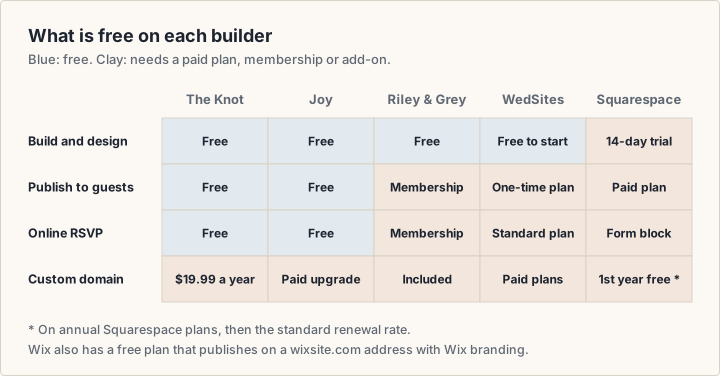
The free platforms earn money elsewhere. Joy says so plainly: registry sales, optional upgrades and vendor recommendations pay for the free tools (Joy pricing (opens in a new tab)). Riley & Grey argues the reverse case: no ads and no upsell, in return for a membership (Riley & Grey pricing (opens in a new tab)). Neither model is wrong. Decide which trade you prefer: upgrade prompts and registry partners, or a fee.
What to check before you commit
Can you publish free, or only design? Is RSVP in the free tier? What does the custom domain cost, and does it renew on its own? What are the fees on cash funds? How long does the site stay online after the wedding?
What a wedding website costs in the first year
For a typical engagement of about a year, the cost is the plan plus the domain. The chart below uses only USD prices the vendors published. The Knot and Joy cost nothing without a domain. Joy itself says a custom domain from a domain provider typically costs $20 to $40 a year (Joy (opens in a new tab)).
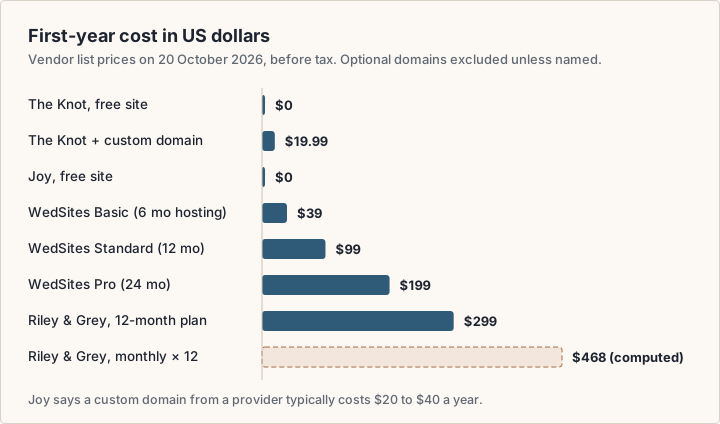
Two numbers are easy to miss. WedSites Basic includes 6 months of hosting, so a site created a year out may need extra hosting before the day (WedSites pricing (opens in a new tab)). On Riley & Grey, eight monthly payments ($312) already cost more than the $299 annual plan, so pick the plan by how long the site needs to stay live (Riley & Grey pricing (opens in a new tab)).
Guest privacy and wedding website passwords
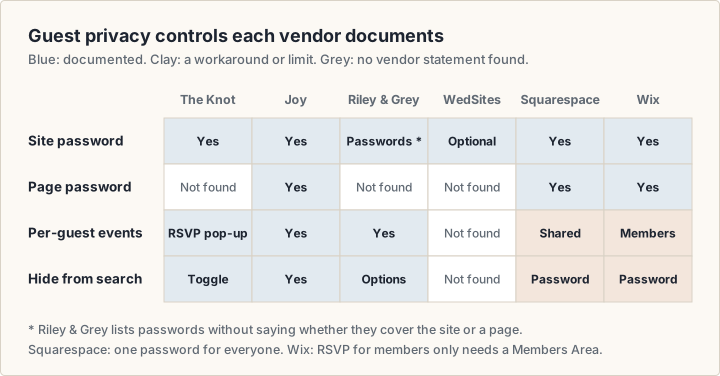
Your site shows your date and venue to anyone who finds it. Three controls limit that: a password, per-guest visibility and search engine settings. The vendors document them differently.
Passwords
On The Knot, one password covers the whole site, and only guests you give it to can view the site. The Knot says you cannot make the site fully private without a password (The Knot Help Center (opens in a new tab)). Squarespace offers a site-wide password and page passwords; everyone shares the same password, and a visitor's session ends after four hours (Squarespace Help (opens in a new tab)). Wix lets you protect one page or the whole site, and protected pages are not indexed by search engines (Wix Help (opens in a new tab)).
Per-guest visibility
A password is all or nothing. Per-guest visibility lets you invite some guests to the rehearsal dinner without announcing it to everyone else. Joy shows each guest only the events they are invited to (Joy (opens in a new tab)). On The Knot, a private event never appears on the site; invited guests see it only in the RSVP pop-up (The Knot Help Center (opens in a new tab)). On Wix, you can limit event RSVP to approved site members, which needs a Members Area (Wix Help (opens in a new tab)).
Search engines and couple search
The Knot runs a couple search tool: anyone with your first name, at least two letters of your last name and the wedding date can look up your site (The Knot Help Center (opens in a new tab)). You can switch off "Appear in search engines" in the privacy settings; The Knot says it can take up to 30 days to drop out of results (The Knot Help Center (opens in a new tab)). On Squarespace, a password set before you add content keeps the page out of search engines from the start; a password added later only stops further indexing (Squarespace Help (opens in a new tab)).
A simple rule
Share the password on the invitation, not on social media. Leave your home address off the site; collect mailing addresses through the RSVP form or guest list instead.
Custom domains for wedding websites
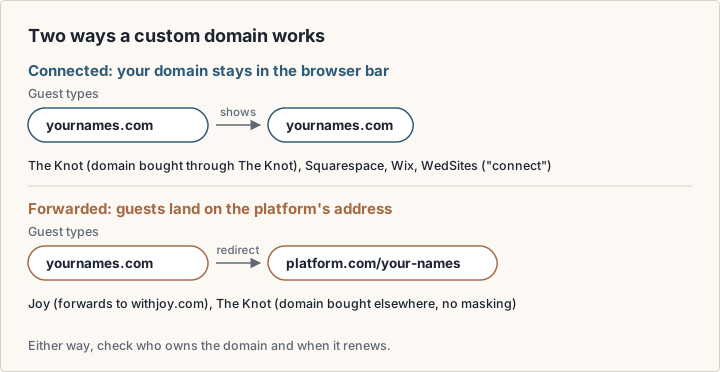
A custom domain works in one of two ways. A connected domain becomes the site's address, so guests see your name in the browser bar. A forwarded domain sends guests on to the platform's address, so the long address shows after the jump.
The details differ by platform:
- The Knot: a domain bought through The Knot becomes the site's primary address. A domain you already own only redirects, with no masking, so guests may see the original address (The Knot Help Center (opens in a new tab)).
- Joy: you can buy a domain from Joy or use your own, and it forwards to your withjoy.com address (Joy (opens in a new tab)).
- Riley & Grey: the domain is part of the membership, and Riley & Grey transfers it to you on request when you leave (Riley & Grey pricing (opens in a new tab)).
- WedSites: every paid plan lists "Connect your custom domain" (WedSites pricing (opens in a new tab)).
- Squarespace: annual plans include a free domain for the first year, which then renews at the standard rate (Squarespace pricing (opens in a new tab)).
- Wix: most yearly Premium plans include a one-year voucher for a new domain bought from Wix (Wix plans (opens in a new tab)).
Check the renewal date against your wedding date. The Knot domains do not auto-renew (The Knot Help Center (opens in a new tab)), and a free first-year domain on Squarespace renews at the standard rate. If your printed invitations carry the domain, it must stay live until after the last thank-you note.
How to choose a wedding website builder
No single builder suits every couple. Start from the constraint that matters most to you.
- Lowest cost: The Knot and Joy publish free with RSVP and registry. For a custom domain, budget $19.99 a year on The Knot, or $20 to $40 a year from a provider by Joy's estimate.
- Per-guest events, such as a rehearsal dinner for family only: Joy, Riley & Grey and The Knot's private events all handle this.
- No ads or upsell: Riley & Grey charges for a membership instead; WedSites charges once and lists an ad-free planning dashboard (WedSites (opens in a new tab)).
- Guests abroad: The Knot warns that some guests outside the US may not reach its site, so test the link from abroad before you print it.
- Design first, or a site you already pay for: Squarespace or Wix, with an RSVP form you build and a registry block or links.
- Planning tools in the same place: WedSites Pro and Joy both bundle checklists or a planning dashboard with the site.
Whichever you pick, build the site early. Joy suggests creating it once you have a date and a venue, and sharing it about six to eight months before the wedding (Joy (opens in a new tab)). Then compare that date with the hosting period of your plan and the renewal date of your domain.
Frequently asked questions
Is there a free wedding website builder?
Yes. The Knot and Joy both let you build and publish a wedding website with RSVP for free; the custom domain is a paid extra (The Knot Help Center (opens in a new tab), Joy pricing (opens in a new tab)). Wix also has a free plan, but it shows Wix branding on a wixsite.com address (Wix plans (opens in a new tab)).
What is the best wedding website builder?
It depends on what you need most: free publishing, per-guest privacy, no ads, or design control. This guide does not rank the builders, because listing.sh did not test them. Use the checklist and the comparison above to match a builder to your list.
How much does a wedding website cost?
From $0 on The Knot and Joy, plus a domain if you want one. The Knot charges $19.99 a year for a domain. WedSites charges $39 to $199 once, and Riley & Grey $299 a year or $39 a month, as of October 2026 (WedSites pricing (opens in a new tab), Riley & Grey pricing (opens in a new tab)).
Can I make a wedding website on Squarespace or Wix?
Yes. Both offer wedding templates and password protection (Squarespace Help (opens in a new tab), Wix wedding templates (opens in a new tab), Wix Help (opens in a new tab)). You build the RSVP with a form, and you need a paid plan for a custom domain. Squarespace's guide also covers a Zola registry block and donation blocks for cash gifts.
Should a wedding website have a password?
If your site shows the venue, date and schedule, a password keeps it to invited guests. Print the password with the invitation. On The Knot and Squarespace, guests all share one password (The Knot Help Center (opens in a new tab), Squarespace Help (opens in a new tab)).
What happens to the website after the wedding?
That depends on the plan. WedSites plans include 6 to 24 months of hosting, with extra hosting from $5 a month (WedSites pricing (opens in a new tab)). On The Knot, a lapsed domain falls back to the free address, and your content stays (The Knot Help Center (opens in a new tab)). On Riley & Grey, the site is published while your membership runs (Riley & Grey pricing (opens in a new tab)).
Sources
- The Knot Help Center: Are wedding websites on The Knot free to use? (opens in a new tab)
- The Knot Help Center: How do I purchase a custom domain for my wedding website? (opens in a new tab)
- The Knot Help Center: Can I add a password to my Wedding Website? (opens in a new tab)
- The Knot Help Center: How do private events work? (opens in a new tab)
- The Knot Help Center: How do I remove my Wedding Website or Registry from Google results? (opens in a new tab)
- The Knot Help Center: How do I search for a couple's wedding website? (opens in a new tab)
- The Knot Help Center: How do I share multiple wedding registries with guests? (opens in a new tab)
- The Knot Help Center: How do I use the RSVP feature on my wedding website? (opens in a new tab)
- The Knot Help Center: Why can't my wedding website be viewed by guests who live in other countries? (opens in a new tab)
- Joy: Wedding website (opens in a new tab)
- Joy: Pricing (opens in a new tab)
- Riley & Grey: Pricing and plans (opens in a new tab)
- Riley & Grey: Home page (opens in a new tab)
- WedSites: Home page (opens in a new tab)
- WedSites: Pricing (opens in a new tab)
- Appy Couple: Pricing (opens in a new tab)
- Squarespace: Pricing (opens in a new tab)
- Squarespace Help: Building a wedding site (opens in a new tab)
- Squarespace Help: Zola blocks (opens in a new tab)
- Squarespace Help: Site-wide passwords (opens in a new tab)
- Squarespace Help: Page passwords (opens in a new tab)
- Wix: Plans and pricing (opens in a new tab)
- Wix Help: Password protecting a specific page of your site (opens in a new tab)
- Wix Help: Wix Events, creating a private event (opens in a new tab)
- Wix: Wedding website templates (opens in a new tab)