An AI image detector estimates whether a picture was made or changed by a generative AI model. It returns a probability, not a fact, and people who ask "is this image AI generated?" usually need to act on the answer.
This guide covers the signals detectors use, their documented limits, a step-by-step check, and seven tools compared. listing.sh did not test these detectors. Every feature, price and accuracy figure below is what the vendor or standards body states, as of October 2026.
How AI image detectors work
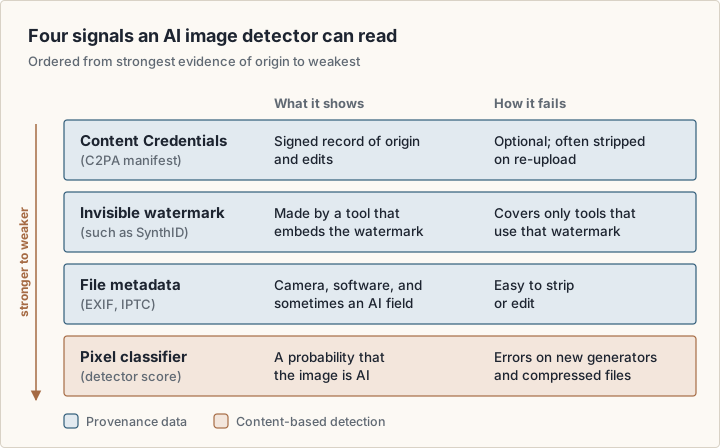
An "AI image detector" can read four kinds of evidence, and each fails differently. The US National Institute of Standards and Technology (NIST) report NIST AI 100-4 (opens in a new tab) (November 2024) splits them into provenance data, such as watermarks and metadata, and content-based detection of the image itself.
Classifiers that read the pixels
Most AI image checkers are classifiers: models trained on real and generated images that output a score. Hive, for example, says its model was trained on "millions of artificially generated images and human-created images" and returns both an AI-generated score and the likely source model (Hive documentation (opens in a new tab)).
NIST lists the features these models use: visible ones, such as shadows that do not match the lighting, and invisible ones, such as spatial frequencies, compression differences found by error level analysis, and "fingerprint" patterns left by camera sensors or generative models (NIST AI 100-4 (opens in a new tab), pages 23 to 25).
File metadata
Image files carry metadata such as camera model, capture time and editing software, and sometimes a field that says AI made them. In 2023, Google said every image generated by its AI would carry such markup in the original file (Google, October 2023 (opens in a new tab)).
Metadata is easy to lose. NIST notes that metadata "can similarly be stripped altogether, as it often is when files are shared (e.g., via social media platforms)", and that anyone who edits a file can falsify it (page 16).
Content Credentials (C2PA)
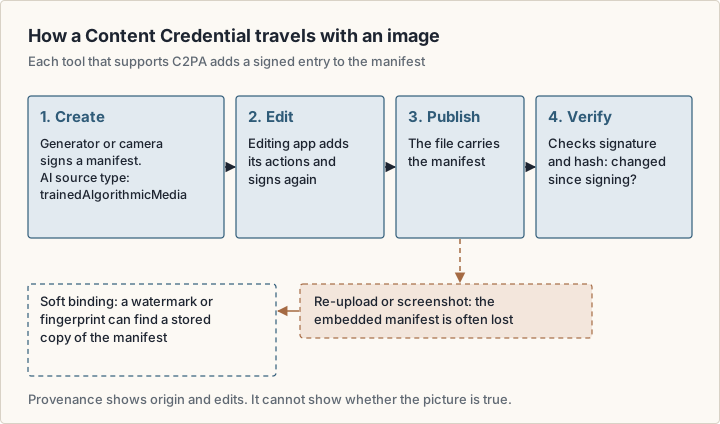
Content Credentials is the non-technical name for a C2PA manifest: statements about an asset's origin and edits, digitally signed by the software or hardware that made them (C2PA Explainer 2.4 (opens in a new tab)). When a generative model creates an image, the manifest records the source type as trainedAlgorithmicMedia (C2PA specification 2.4 (opens in a new tab)). A verifier checks the signature and a hash, so it can tell whether the image changed after signing.
According to contentcredentials.org (opens in a new tab), hundreds of companies back the standard, led by Microsoft, Adobe, Intel, BBC, Truepic, Sony, Publicis Groupe, OpenAI, Google, Meta and Amazon. The C2PA states the limit: provenance "alone cannot tell you whether the digital content is true, accurate or factual", and the metadata can be removed.
Invisible watermarks such as SynthID
A watermark hides in the pixels, so it can survive where metadata does not. Google DeepMind's SynthID adds an invisible watermark to images from Google's AI at the moment they are created. Google says it is "designed to stand up to modifications like cropping, adding filters, changing frame rates, or lossy compression" (Google DeepMind (opens in a new tab)). By May 2025, Google reported over 10 billion pieces of content watermarked with SynthID (Google (opens in a new tab)).
A watermark answers one narrow question: did a tool that uses it make the image? SynthID Detector covers Google and named partners (OpenAI, NVIDIA, Kakao, and Apple soon), so "not found" says nothing about other generators. The C2PA also uses watermarks as a "soft binding" that can find a stored manifest after the embedded one is gone (C2PA Explainer 2.4 (opens in a new tab)).
Why AI image checkers get it wrong
Detectors make two kinds of mistakes. A false positive flags a real photo as AI. A false negative passes a generated image as real. NIST's research review names the main causes (NIST AI 100-4 (opens in a new tab), pages 22 and 27):
- New or unknown generators. Detectors "trained on images from a particular generator perform better on images generated by the same generator than on other synthetic images". In tests across generators, one 2023 paper reported accuracy of 61% to 70%, and a 2022 paper reported 50% to 62%.
- Compression and resizing. NIST reports substantial error rates across generators, "particularly after post-processing (e.g., compression and resizing)".
- Partial edits. An image with one object filled in by AI (inpainting) is mostly real, so a whole-image score can go either way.
- An arms race. NIST calls detection "a constant cat-and-mouse game", and detectors often work well only on specific generators.
- Lost or false metadata. Metadata may be stripped in transit or edited, and detecting a watermark "always comes with some probability of error".
People are no backstop: NIST cites a 2024 study that found human performance near chance on AI-generated images, video and audio.
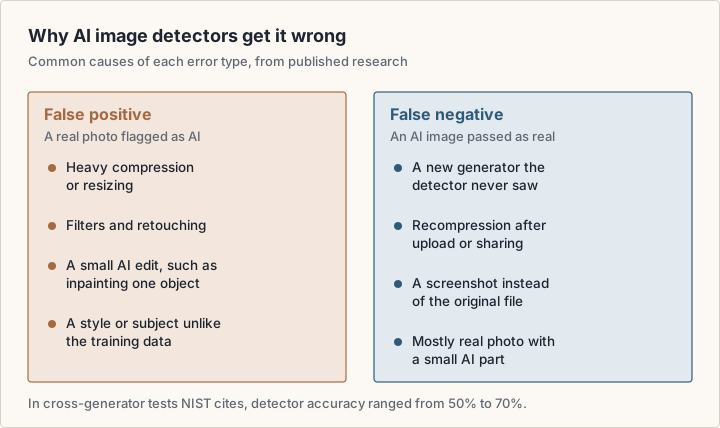
NIST describes detector output as "a score representing the probability that a piece of content is synthetic". The cutoff for "AI" is a choice: Hive tells customers to refine its recommended thresholds for their use case (Hive documentation (opens in a new tab)). WasItAI says screenshots "may decrease detection quality" (WasItAI (opens in a new tab)), and Hive recommends reading its response "holistically", because metadata can be stripped or falsified.
How to check if an image is AI generated
No single check is conclusive, so combine several, as NIST suggests: "looking jointly at provenance metadata, watermarks, perceptible and imperceptible cues, context" (page 29). Work from the strongest evidence to the weakest:
- 1Find the earliest copy. Run a reverse image search. Google's About this image, in the three-dot menu on a Google Images result, shows when Google Search first saw the image and what other pages, including fact-checkers, say about it (Google (opens in a new tab)). An earlier copy is usually closer to the original file.
- 2Read the Content Credentials. Upload the file to Content Credentials Verify (opens in a new tab) or Adobe's Inspect tool. Inspect shows the signer, the edit actions, and an "AI-generated" note when a generative tool made the image. It labels a signer not on the C2PA trust list "Unrecognized" (Inspect documentation (opens in a new tab)).
- 3Check for a watermark. If the image could come from Google's models or a SynthID partner, upload it to SynthID Detector, or ask Gemini whether Google AI created or altered it (Google DeepMind (opens in a new tab)).
- 4Run one or two detectors on the original file, not a screenshot. If they disagree, treat the result as unknown.
- 5Look at the details and the context. NIST lists cues such as shadows that do not match the lighting, artifacts where an object meets the background, and mismatched earrings or eye reflections. Then ask who posted it first, and whether the claim makes sense.
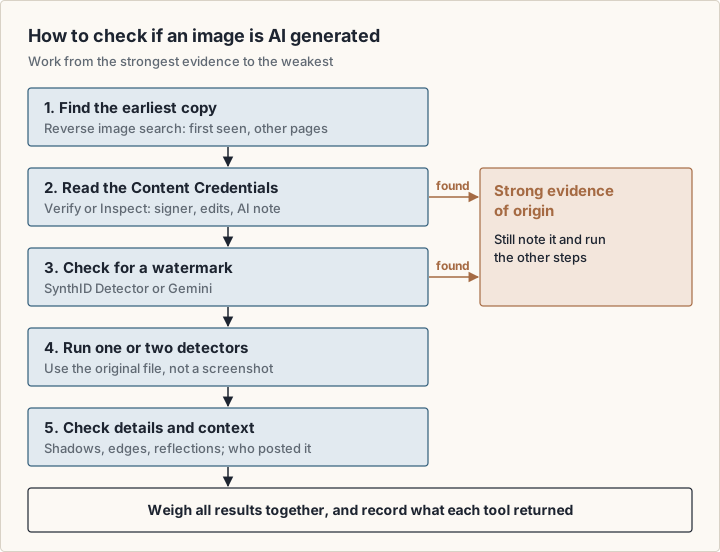
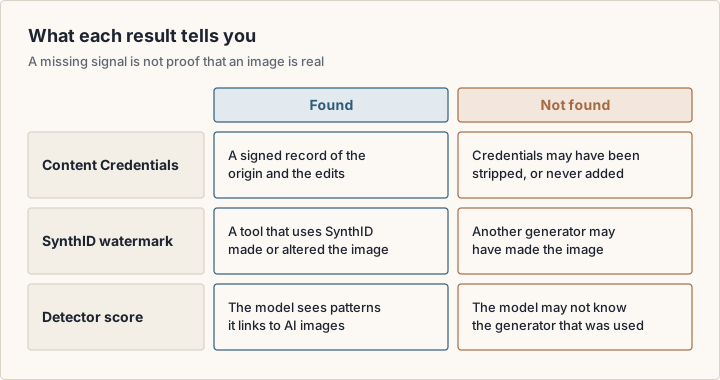
Weigh the results in the same order. A valid Content Credential or a detected watermark is strong evidence of origin; a detector score is weaker; visual cues are weakest, because generators improve quickly. A missing signal proves little: the C2PA states that adding provenance is optional, and that no one should judge an asset's trustworthiness purely on whether it uses Content Credentials (C2PA Explainer 2.4 (opens in a new tab)).
When the stakes are high
For news, legal or money decisions, do not rely on a free online check. Keep the original file, record each result, and ask the source for the camera original.
AI image detectors compared
These tables list what each vendor documents, as of October 2026. listing.sh did not test these tools, and accuracy figures are vendor claims, not verified results. Check each vendor page before you sign up.
| Feature | What it checks | Free use |
|---|---|---|
| Hive | AI-image classifier plus a per-face deepfake model. Names the likely generator; returns C2PA metadata if present. | Hive Detect web tool and Chrome extension. API: $50+ free credits after adding a payment method. |
| Sightengine | Pixel-based classifier; the vendor says results do not depend on metadata. | Web check. API: 2,000 operations a month, max 500 a day. |
| Winston AI | Classifier plus EXIF, IPTC and C2PA metadata, error level analysis and noise maps. | 2,000 credits, 14-day trial. JPEG, PNG, WebP up to 10 MB. |
| Illuminarty | Classifier; paid plans add localized detection and generator identification. | Basic image classification. |
| WasItAI | Classifier with a confidence score; browser extension. | 10 images a month; files up to 8 MB. |
| Content Credentials (Verify, Inspect) | Validates a C2PA manifest: signer, edits, AI-generated note. | Web upload; no price shown. |
| SynthID Detector | Looks for a SynthID watermark and marks likely areas. | Google says access is expanding to everyone; Gemini can also check. |
| Feature | API and paid plans | Accuracy claim (vendor's own words) |
|---|---|---|
| Hive | $6.00 per 1,000 image requests; enterprise on request. | No figure stated. |
| Sightengine | Starter $29 a month (10,000 operations); Pro $99 (40,000). | Cites a University of Rochester and University of Kansas study of 80,000 images: "the highest accuracy". |
| Winston AI | Image detection API. Essential $18 a month on monthly billing (100,000 credits). | "the only AI image detector with an accuracy rate above 98%" |
| Illuminarty | Basic $10 a month (API, 10,000 requests a day); Pro $30 (40,000). | No figure stated. |
| WasItAI | API on every plan. Basic $3.99 a month (100 images) to Pro $300 (10,000). | No figure stated. |
| Content Credentials (Verify, Inspect) | Built on the open C2PA specification. | Not a score: valid signature or no credential. |
| SynthID Detector | No pricing shown. | Not a score: watermark found or not. |
The classifiers give a probability for any image, backed by vendor claims or a benchmark the vendor cites. The provenance tools give a yes-or-no answer, but only for images from tools that sign or watermark their output. Most checks need one of each.
If you publish AI images yourself
Detection works better when publishers label their own AI images. If you use AI features in a design tool such as Canva, or make clips with text-to-video tools, keep the export that carries Content Credentials where the tool adds them, and say in the caption that AI was used.
For real photographs, use a licensed library such as Unsplash, whose license allows free commercial and non-commercial use (Unsplash License (opens in a new tab)).
Frequently asked questions
Is there a free AI image detector?
Yes. Hive Detect, Sightengine's web check, Illuminarty's basic classification and WasItAI's free plan of 10 images a month cost nothing, as of October 2026. Content Credentials Verify and SynthID Detector show no price on their pages. Free tiers have caps.
Are AI image detectors accurate?
It depends on the image and the generator. Two studies cited by NIST measured 50% to 70% accuracy on generators the detectors were not trained on. Vendor figures, such as Winston AI's "above 98%", are the vendors' own claims. listing.sh has not verified them.
Is this picture AI generated if a detector says 50%?
A score near the middle means the model is unsure. Read it as neither yes nor no, and move on to the provenance, watermark and context checks.
Can an AI photo checker tell which generator made an image?
Some say so: Hive returns a likely source model, and Illuminarty's paid plans identify the generator. Treat that as another estimate. Only a signed Content Credential records which tool made the file.
Can a real photo be flagged as AI generated?
Yes, that is a false positive. Compression, editing and small AI touch-ups can push a score up. Test the original file and compare more than one signal.
Does a screenshot change the result?
Often. A screenshot is a new file without the original metadata or Content Credentials, and WasItAI warns that screenshots may decrease detection quality.
Sources
- NIST AI 100-4: Reducing Risks Posed by Synthetic Content, November 2024 (opens in a new tab)
- C2PA Explainer, version 2.4 (opens in a new tab)
- C2PA Technical Specification, version 2.4 (opens in a new tab)
- Content Credentials (contentcredentials.org) (opens in a new tab)
- Content Credentials Verify (opens in a new tab)
- Content Authenticity Initiative: Using the Inspect tool (opens in a new tab)
- Google DeepMind: SynthID (opens in a new tab)
- Google: SynthID Detector announcement, May 2025 (opens in a new tab)
- Google: About this image, October 2023 (opens in a new tab)
- Hive: AI-generated content detection (opens in a new tab)
- Hive documentation: Image and video detection (opens in a new tab)
- Hive pricing (opens in a new tab)
- Sightengine: AI image detection (opens in a new tab)
- Sightengine pricing (opens in a new tab)
- Winston AI: AI image detector (opens in a new tab)
- Winston AI pricing (opens in a new tab)
- Illuminarty (opens in a new tab)
- WasItAI (opens in a new tab)
- WasItAI API and pricing (opens in a new tab)
- Unsplash License (opens in a new tab)