An online advertising platform is where you buy ad space: you set a budget and an audience, and the platform runs an auction each time a placement comes up. Google, Meta and Amazon are the largest by reported advertising revenue. The right one for you depends on where your buyers spend time and what you want them to do.
This guide compares eight paid advertising platforms from their own documentation: Google Ads, Microsoft Advertising, Meta Ads, Amazon Ads, LinkedIn Ads, TikTok Ads, Pinterest Ads and Reddit Ads. listing.sh did not run test campaigns. Every rule and figure comes from vendor help pages and investor filings read in October 2026, so confirm it on the linked page before you commit a budget.
What an online advertising platform does
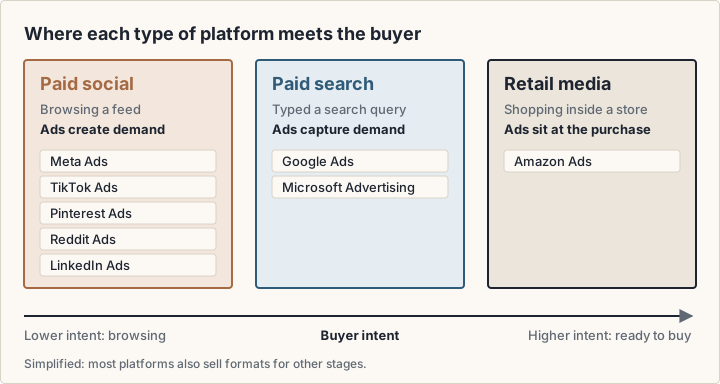
Every platform here works the same way at the core. You create a campaign with a goal, a budget and targeting. Each time a person loads a search page, a feed or a product page, the platform runs an auction among eligible ads and charges the winners per click, per thousand impressions, per view or per action. What differs is what the platform knows about the person at that moment:
- Paid search (Google Ads, Microsoft Advertising): the person typed a query, so the ad meets existing demand.
- Paid social (Meta, TikTok, Pinterest, Reddit, LinkedIn): the person is browsing a feed, so the ad creates demand from interests, communities or job details.
- Retail media (Amazon Ads): the person is shopping inside a store, so the ad sits next to the purchase.
PPC marketing (pay-per-click) means buying any of these by the click. Paid search campaigns are the subset on search results pages. Most platforms also sell by impression or by action, so pay-per-click advertising platforms and paid advertising platforms overlap, but are not the same list.
The big 3 of online advertising, by reported revenue
Who are the big 3 of online advertising? Alphabet, Meta and Amazon, by the advertising revenue each reported for 2025.
| Feature | 2025 advertising revenue | What the figure covers |
|---|---|---|
| Alphabet (Google) | $294.7 billion | Search, YouTube and Network ads (10-K) |
| Meta | $196.2 billion | Advertising revenue; $160.6 billion in 2024 (10-K) |
| Amazon | About $68.6 billion | Sum of four quarterly advertising services figures |
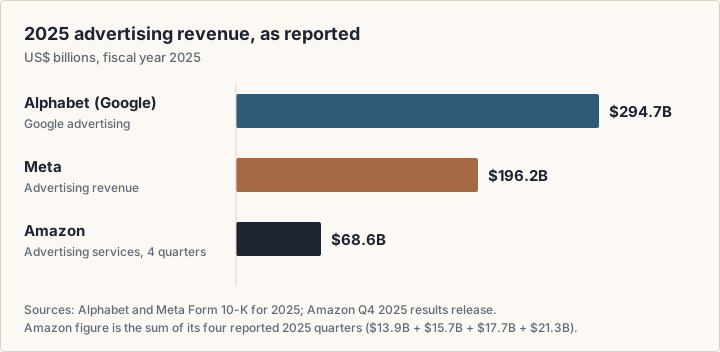
Sources: Alphabet 10-K (opens in a new tab), Meta 10-K (opens in a new tab) and Amazon Q4 2025 results (opens in a new tab). Amazon reports advertising by quarter, so its annual figure is our sum of the four 2025 quarters.
Other platforms publish audience numbers instead. Meta reported 3.58 billion daily active people across its apps on average in December 2025 (Meta 10-K (opens in a new tab)). Pinterest reported 619 million monthly active users (Pinterest 10-K (opens in a new tab)). Reddit reported 121.4 million daily active uniques on average in the fourth quarter of 2025, across more than 100,000 active communities (Reddit 10-K (opens in a new tab)). Microsoft does not report one advertising total, but said search advertising revenue, excluding traffic acquisition costs, grew 10% in the fourth quarter of its 2026 fiscal year (Microsoft FY26 Q4 (opens in a new tab)). Size shows where the inventory is, not which platform will pay off for your product.
How pay-per-click advertising platforms run the auction
The highest bid does not automatically win. Google's help page About Ad Rank (opens in a new tab) lists six inputs to Ad Rank, the set of values that decides whether an ad can show and where it appears:
- Your bid
- The quality of your ads and landing page
- The Ad Rank thresholds
- The competitiveness of the auction
- The context of the person's search
- The expected impact of your ad assets and other ad formats
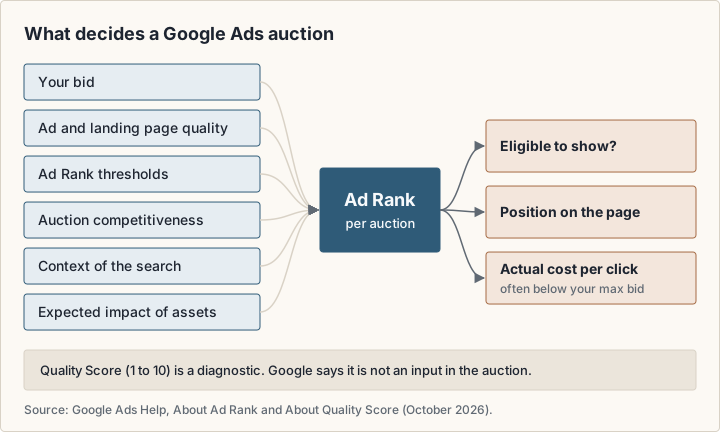
So you usually pay less than your maximum bid, and a better ad can beat a bigger bid. Google says what you pay "is often less" than your bid, and that higher-quality ads can lead to lower costs per click (How the Google Ads auction works (opens in a new tab)).
Google's Quality Score (opens in a new tab) is a 1 to 10 rating per keyword, built from expected clickthrough rate, ad relevance and landing page experience. Google calls it a diagnostic tool and says it is not an input in the auction. Treat it as a hint, not a target.
Social platforms use the same idea with different signals. Meta's bidding overview (opens in a new tab) says its auction weighs your bid strategy, your bid amount and the probability that the person completes your optimisation goal.
Online advertising platforms compared
The table gives the short version. The sections after it cover each platform. Names are the vendors' own, as of October 2026.
| Feature | Bidding options | Budget rule to know |
|---|---|---|
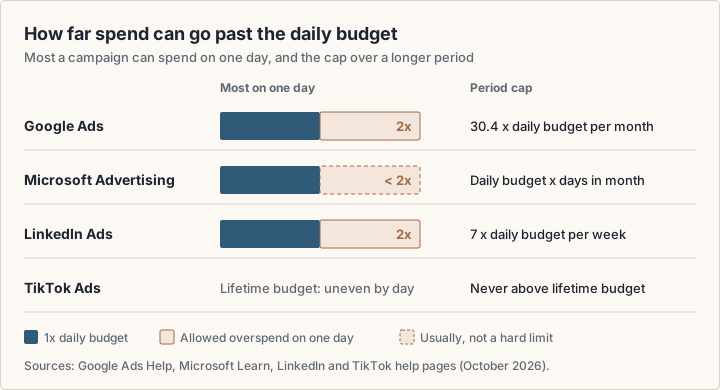
| Google Ads | Smart Bidding (Target CPA, Target ROAS, Maximize conversions or value), Maximize clicks, Manual CPC, CPM, CPV | Can spend up to 2x the average daily budget on one day, and no more than 30.4x in a month |
| Microsoft Advertising | Enhanced CPC, Manual CPC, Maximize clicks, Maximize conversions, Target CPA, Target ROAS | Budget is a target; overspend is usually under 100% above the daily limit |
| Meta Ads | Lowest cost, cost cap, minimum ROAS, bid cap | Minimum daily budget depends on the billing event and the country |
| Amazon Ads | Cost per click for sponsored ads; CPC or vCPM for Sponsored Brands | Sponsored ads have no minimum spend; you set a daily budget |
| LinkedIn Ads | Maximum delivery, cost cap, manual bidding | Daily spend can run up to 100% over the daily budget; weekly spend is capped at 7x |
| TikTok Ads | Target cost per result, Maximum Results; billed by CPM, oCPM, CPV or CPC | Campaign daily budget must exceed $50; ad group daily budget must exceed $20 |
| Pinterest Ads | Performance+ (managed by Pinterest) or Custom: maximum CPM, maximum CPC or target CPA | Bid floors depend on campaign type, format and country |
| Reddit Ads | Auto-bidding such as Maximum Clicks and Maximum Conversions | Not confirmed: check minimums in Reddit Ads Manager |
Google Ads
Google Ads sells Search, Performance Max, Display, Video, App and Shopping campaigns (campaign types (opens in a new tab)). Performance Max is goal-based and uses Google AI to reach all Google Ads inventory from one campaign.
Search targeting starts with keywords and three match types (opens in a new tab): broad (searches related to your keyword), phrase (searches that include its meaning) and exact (same meaning or intent). Audience segments (opens in a new tab) add affinity, in-market, life events, demographics, custom segments and Customer Match lists from your CRM.
Google's budget page (opens in a new tab) states no minimum. A campaign can spend up to twice its average daily budget on one day, but no more than 30.4 times it in a month (overdelivery rules (opens in a new tab)).
What to check: run Keyword Planner (opens in a new tab) first. It estimates monthly searches, the average cost to show on a keyword, and what a given spend might buy. It needs an account with billing details.
Microsoft Advertising
Microsoft Advertising shows search ads on Bing, Yahoo, DuckDuckGo and other search engines, and display and native ads across MSN, Microsoft Edge, Outlook and Microsoft Casual Games (Microsoft Advertising (opens in a new tab)).
Its distinct feature is LinkedIn profile targeting (opens in a new tab): you can target people by company, industry or job function from their LinkedIn profile. Automated bid strategies (opens in a new tab) include Enhanced CPC, Maximize clicks, Maximize conversions, Target CPA and Target ROAS. Conversion-based strategies need a UET tag and a conversion goal. They stop optimising if a campaign falls below 30 conversions in any 30-day period (budget and bid strategies (opens in a new tab)).
Microsoft can import campaigns from Google Ads (opens in a new tab), including ads, targets and ad extensions, once or on a schedule. What to check: review each import, because Microsoft says not all information comes across.
Meta Ads
Meta Ads can place ads on Facebook, Instagram, Threads, Messenger and the Audience Network of partner apps. Positions include Feed, Stories, Reels, Marketplace and in-stream video; with no placements chosen, Meta uses all default positions (placement targeting (opens in a new tab)). Campaigns use one of six objectives (opens in a new tab): awareness, traffic, engagement, leads, app promotion and sales.
Bid strategies (opens in a new tab) run from fully automatic to capped. Lowest cost bids for the cheapest results with no limit. Cost cap aims at the cost per result you set. Minimum ROAS sets a floor on return for value optimisation. Bid cap never goes above your maximum bid. Capped options can leave budget unspent.
What to check: Meta's ad set reference (opens in a new tab) lists illustrative minimum daily budgets in US dollars. They are $0.50 for impressions, $2.50 for clicks, likes and video views, and $40 for low-frequency actions such as app installs. For accounts in the US, the UK, Canada and other listed countries they double. Also check whether your ad is in a special ad category (opens in a new tab): housing, employment, financial products and services, or social issues, elections and politics.
Amazon Ads
Amazon Ads is retail media. Sponsored Products (opens in a new tab) are cost-per-click ads for single product listings, shown in the Amazon store and on other Amazon-owned sites, with no monthly or upfront fees. You set a daily budget and a maximum bid, and target by keyword or product, or let Amazon pick keywords automatically.
Sponsored Brands (opens in a new tab) promote a brand with video, image or collection ads above, beside or within shopping results. They are priced per click or per thousand viewable impressions (vCPM), depending on the goal, and sellers must be enrolled in Amazon Brand Registry. Amazon DSP (opens in a new tab), the programmatic product for display, video, audio and streaming TV, is now part of Amazon Ads Agent; it was open to advertisers who do not sell on Amazon. Amazon says sponsored ads remain cost-per-click with no minimum spend.
What to check: sponsored ads need Amazon listings. Professional sellers, vendors, book vendors and Kindle Direct Publishing authors are eligible.
LinkedIn Ads
LinkedIn sells Sponsored Content (single image and video ads in the feed), Sponsored Messaging (conversation and message ads in the inbox) and Dynamic Ads (spotlight, follower and job ads) (message ads specifications (opens in a new tab)). Targeting (opens in a new tab) uses profile data: job title, job function, seniority, member skills, company name, company industry and company size, plus Matched Audiences for retargeting. An ad set needs an audience of at least 300 member accounts.
Bidding (opens in a new tab) is maximum delivery (automated), cost cap (a target cost per key result) or manual. Daily spend can be up to 100% above the daily budget on one day, and weekly spend is capped at seven times it on a continuous schedule (budgets (opens in a new tab)).
What to check: in the EEA and Switzerland, Sponsored Messaging reaches only members who opted in. Campaign Manager shows the minimum lifetime budget for your schedule.
TikTok Ads
TikTok Ads can run on TikTok (and TikTok Lite where available), Lemon8, the Global App Bundle of apps such as CapCut, and the TikTok Ad Network of partner publishers, formerly Pangle (eligible placements (opens in a new tab)). You choose the placement when you create an ad group, and you cannot change it later. Spark Ads (opens in a new tab) let you run organic TikTok posts as ads, from your own account or from creators who give permission.
The bid strategy (opens in a new tab) is Target cost per result or Maximum Results (names from TikTok's September 2026 help page). The billing method (opens in a new tab) is CPM, oCPM (the default for conversions and app installs), CPV (charged at a 6-second view or an interaction in the first 6 seconds) or CPC. Targeting (opens in a new tab) covers demographics, audiences, interests and behaviours, and device.
What to check: a campaign daily budget must exceed $50 and an ad group daily budget must exceed $20 (TikTok budgets (opens in a new tab)). Plan the creative before the budget; with no footage, see our guide to creating videos from text.
Pinterest Ads
Pinterest campaign objectives (opens in a new tab) are brand awareness, video completion, consideration, leads and sales. Its 2025 annual report lists shopping ads that promote products from a catalogue, Performance+ as its automated campaign option, and targeting by interests, demographics and search keywords (Pinterest 10-K (opens in a new tab)).
Bids (opens in a new tab) are Performance+ (managed by Pinterest, and the default for most objectives) or Custom. With Custom you set a maximum CPM for awareness, a maximum CPC for consideration, or a target average CPA for leads and sales. Video completion is Performance+ only.
What to check: bid floors depend on campaign type, format and country, and the highest floor applies. Pinterest says you pay only the minimum needed in each auction.
Reddit Ads
Reddit's help center did not load when we prepared this guide, so this summary comes from Reddit's 2025 annual report (opens in a new tab). Ads run in the home feed and inside conversations. You can target by interest, by relevant communities and conversations, and by keyword. Formats include Dynamic Product Ads built from a catalogue.
Objectives run from impressions and traffic to conversions and installs. What to check: confirm budget and bid minimums in Reddit Ads Manager, and learn each community's norms first; our 15-minute routine for X and Reddit covers the organic side.
How to choose a bid strategy
Names differ, but the logic is shared. Google groups its bid strategies (opens in a new tab) by goal: conversions, clicks, visibility and views. Other platforms map onto those groups.
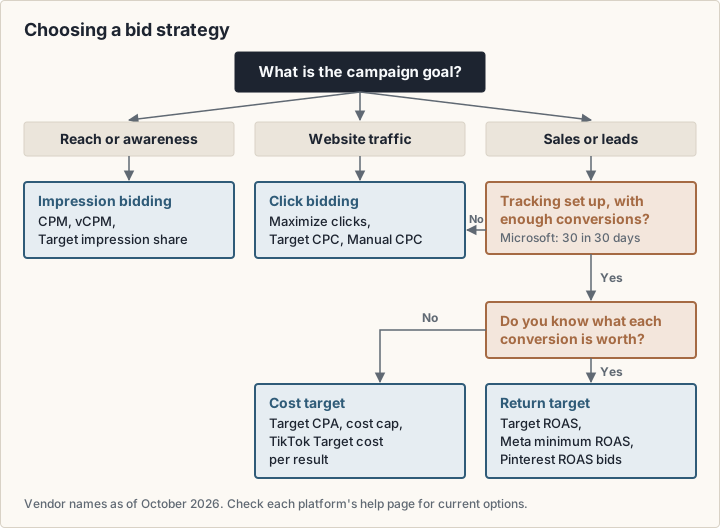
- 1Can the platform see your conversions? If not, install its tracking tag first.
- 2Is there enough volume? Microsoft's conversion strategies stop optimising below 30 conversions in 30 days. Below that, bid for clicks while you collect data.
- 3Do you know each conversion's value? If yes, use a return target (Target ROAS, Meta minimum ROAS). If not, use a cost target (Target CPA, cost cap, TikTok Target cost per result).
Automated strategies hand control to the platform. Google's Smart Bidding (opens in a new tab) sets bids at auction time from signals such as device, location and time of day.
How paid search campaigns are structured
Paid search accounts nest the same way on Google and Microsoft. A campaign holds the budget, the locations and the bid strategy. Inside it, each ad group covers one narrow theme, with the keywords and ads for that theme. Google recommends at least three ads per ad group (organise your account (opens in a new tab)).
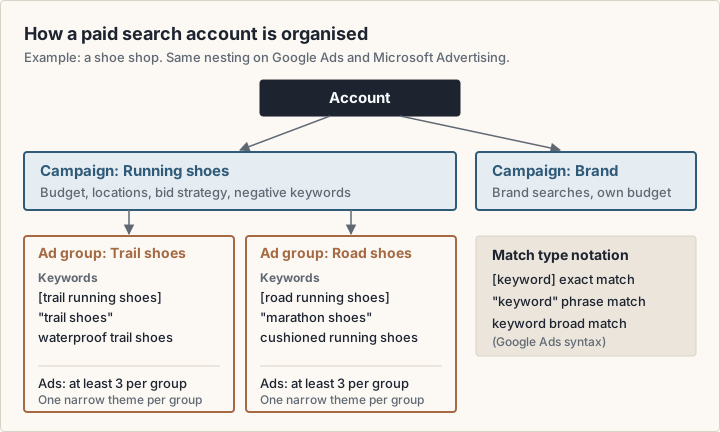
Match types decide how far a keyword stretches. In Microsoft's example (opens in a new tab), the broad match keyword red flower can match the search red carnation. Add negative keywords for terms you never want to pay for.
Before you bid on a term, check whether your site already ranks for it. Google Search Console shows the queries your pages already appear for in organic results.
A worked budget and CPC example
Example numbers
All numbers in this section are made up to show the arithmetic. They are not benchmarks for any platform or industry.
Say you set an average daily budget of $30 on a Google Ads search campaign. Google can spend up to $60 on a busy day, but it caps the month at 30.4 x $30 = $912. At an average cost per click of $1.50, $912 buys about 608 clicks. At a 3% conversion rate, that is about 18 conversions, so a cost per conversion of about $50.
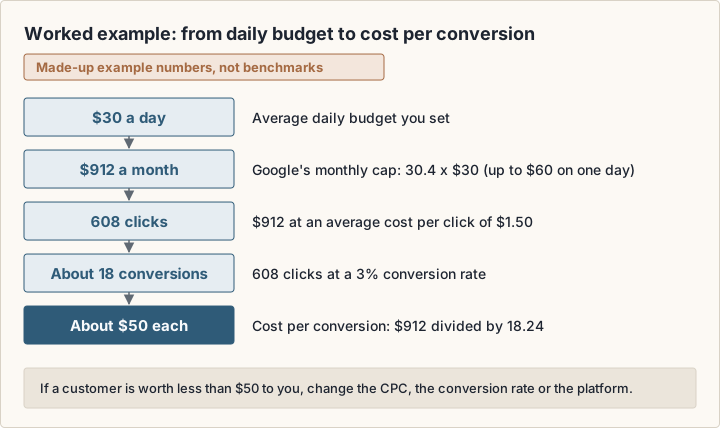
Now run it backwards. If a customer is worth $40 in profit, a $50 cost per conversion loses money. The auction sets the price of a click; your offer and landing page decide what the click is worth.
Budget rules also differ in how far one day can exceed the daily budget. The platform sections above link each rule.
What is the best platform for online advertising?
No single platform is best for online advertising. It depends on your goal, your audience and your creative. Stop at the first yes:
- 1Do people already search for what you sell? Start with Google Ads, then import the campaigns to Microsoft Advertising.
- 2Do you sell on Amazon? Use Sponsored Products.
- 3Is your buyer defined by job or company? Use LinkedIn Ads, or Microsoft's LinkedIn profile targeting on search.
- 4Do you need to create demand people do not search for yet? Use paid social on Meta, TikTok or Pinterest, picked by the creative you can make.
- 5Does your audience gather in niche communities? Try Reddit.
Whatever the answer, fix conversion tracking first; without it you cannot judge any platform. Then start with one platform and add a second once the first has data. A small budget split across many platforms leaves each one with too little data to optimise.
Privacy, consent and tracking
Conversion data now depends on consent in many regions. Google's EU user consent policy (opens in a new tab) requires you to get legally valid consent from users in the EEA, the UK and Switzerland for cookies, where the law requires it, and for personalised ads. Google's consent mode (opens in a new tab) passes the choices from your cookie banner to its tags. When a user denies consent, those tags do not store cookies and send cookieless pings instead.
Policy also limits targeting by category. On Meta, ads for housing, employment and financial products and services cannot target a gender or use lookalike audiences, and age is generally fixed at 18 to 65+. Meta also says ads about social issues, elections or politics are not allowed to run in the EU from 6 October 2025.
Also measure on your own site. Web analytics such as Plausible or product analytics such as PostHog show what paid visitors do after the click; our PostHog vs Plausible guide compares them.
The other side: platforms that pay publishers
Advertisers buy through the platforms above; site owners sell space through publisher networks such as Google AdSense. In AdSense (opens in a new tab), advertisers bid for your ad spaces in a real-time auction. AdSense picks ads automatically based on your content or audience, and pays you for clicks or impressions. Earnings vary, because advertisers pay different prices for different ads.
Frequently asked questions
What are the top advertising platforms?
By reported 2025 advertising revenue, the largest are Google (Alphabet, $294.7 billion), Meta ($196.2 billion) and Amazon (about $68.6 billion). Microsoft Advertising, LinkedIn, TikTok, Pinterest and Reddit each reach a distinct audience beyond those three.
Who are the big 3 of online advertising?
Alphabet, Meta and Amazon. The ranking comes from the advertising revenue each company reported for 2025 in its own annual report or results release.
What is the best platform for online advertising?
It depends on your goal: search for existing demand, Amazon for Amazon products, LinkedIn for buyers defined by job, and social platforms for new demand.
What is the difference between PPC marketing and paid search marketing?
PPC marketing covers any ad bought by the click, on any platform. Paid search marketing covers ads on search results pages, such as Google Ads and Microsoft Advertising.
How much do paid ads cost?
There is no fixed price. You set the budget, and the auction sets the cost per click or per thousand impressions. Some platforms set floors, such as TikTok's $50 campaign daily minimum. Use Keyword Planner for search estimates.
Can I run paid search campaigns on a small budget?
Yes, but a small budget buys few clicks, and automated bidding needs conversion data. Use tightly themed ad groups, exact or phrase match, and conversion tracking from day one.
Sources
- Alphabet Inc., Form 10-K for fiscal year 2025 (opens in a new tab)
- Meta Platforms, Inc., Form 10-K for fiscal year 2025 (opens in a new tab)
- Amazon.com, Fourth Quarter 2025 results release (opens in a new tab)
- Microsoft, FY26 Q4 press release (opens in a new tab)
- Pinterest, Inc., Form 10-K for fiscal year 2025 (opens in a new tab)
- Reddit, Inc., Form 10-K for fiscal year 2025 (opens in a new tab)
- Google Ads Help: About Ad Rank (opens in a new tab)
- Google Ads Help: How the Google Ads auction works (opens in a new tab)
- Google Ads Help: About Quality Score for Search campaigns (opens in a new tab)
- Google Ads Help: Choose the right campaign type (opens in a new tab)
- Google Ads Help: Determine a bid strategy based on your goals (opens in a new tab)
- Google Ads Help: About Smart Bidding (opens in a new tab)
- Google Ads Help: About keyword matching options (opens in a new tab)
- Google Ads Help: About audience segments (opens in a new tab)
- Google Ads Help: Organize your account with ad groups (opens in a new tab)
- Google Ads Help: About average daily budgets (opens in a new tab)
- Google Ads Help: About overdelivery and your average daily budget (opens in a new tab)
- Google Ads Help: Use Keyword Planner (opens in a new tab)
- Google Ads Help: About consent mode (opens in a new tab)
- Google: EU user consent policy (opens in a new tab)
- Google AdSense Help: How AdSense works (opens in a new tab)
- Microsoft Advertising: homepage (opens in a new tab)
- Microsoft Advertising: Audience targeting (LinkedIn profile targeting) (opens in a new tab)
- Microsoft Advertising: Automated bidding overview (opens in a new tab)
- Microsoft Learn: Budget and bid strategies (opens in a new tab)
- Microsoft Learn: Google Ads import (opens in a new tab)
- Meta for Developers: Bidding overview (opens in a new tab)
- Meta for Developers: Bid strategy (opens in a new tab)
- Meta for Developers: Ad set reference (opens in a new tab)
- Meta for Developers: Ad campaign reference (objectives) (opens in a new tab)
- Meta for Developers: Placement targeting (opens in a new tab)
- Meta for Developers: Special ad categories (opens in a new tab)
- Amazon Ads: Sponsored Products (opens in a new tab)
- Amazon Ads: Sponsored Brands (opens in a new tab)
- Amazon Ads: Amazon DSP (opens in a new tab)
- LinkedIn Marketing Solutions Help: Campaign and ad set bidding strategies (opens in a new tab)
- LinkedIn Marketing Solutions Help: Campaign and ad set budgets (opens in a new tab)
- LinkedIn Marketing Solutions Help: Targeting options for LinkedIn Ads (opens in a new tab)
- LinkedIn Marketing Solutions Help: Message ads advertising specifications (opens in a new tab)
- TikTok Ads Manager: About budget (opens in a new tab)
- TikTok Ads Manager: Available bidding methods (opens in a new tab)
- TikTok Ads Manager: Available bidding strategies (opens in a new tab)
- TikTok Ads Manager: About eligible placement (opens in a new tab)
- TikTok Ads Manager: Ad targeting dimensions (opens in a new tab)
- TikTok Ads Manager: About Spark Ads (opens in a new tab)
- Pinterest Business help: Set and edit your bid (opens in a new tab)
- Pinterest Business help: Select a campaign objective (opens in a new tab)