Building an audience is the single most valuable thing a founder or creator can do — and most people approach it completely wrong. They broadcast into the void, post announcements nobody asked for, and wonder why nothing sticks. The platforms that still reward genuine human engagement are X (formerly Twitter) and Reddit. The challenge isn't knowing that — it's finding the time, and knowing exactly where to show up.
This guide is about a specific, repeatable system: 15 focused minutes per day, every day, using a small set of tools that eliminate the noise and surface only the conversations worth joining. After 30 days, the compounding effect is real. We've tested it across three founders in different niches — developer tools, B2B SaaS, and indie consumer apps — and the results were consistent. Let's break down exactly how it works.
The engagement problem
Here's what most people do: they spend 45 minutes scrolling, maybe like a few posts, retweet something, drop a generic 'Great point!' comment, and call it engagement. That's consumption, not engagement. The platforms know the difference, and more importantly, the audiences know the difference. Real audience growth on X and Reddit comes from consistently showing up in the right conversations — the specific threads where your expertise actually matters — and adding enough value that people instinctively click your profile.
The problem with the traditional approach is signal-to-noise. X's home feed is an engagement-maximizing algorithm, not a relevance-maximizing one. Reddit's front page is dominated by large subreddits that don't reflect the niche communities where your target users actually hang out. If you're manually scanning both platforms looking for conversations to join, you're working harder than you need to — and you're missing most of the relevant threads entirely.
Key insight
The founders who grow the fastest audiences don't spend more time on social media. They spend smarter time — 15 focused minutes where every interaction is intentional and every reply is placed in a conversation where it will actually be seen by the right people.
Why X and Reddit matter most
X gives you reach. Reddit gives you depth. These aren't interchangeable — they serve different stages of your audience-building flywheel. On X, a single well-crafted reply to a thread with 10,000 impressions can land your profile in front of people who've never heard of you. The format rewards brevity and insight. Your reply needs to add something the original post didn't — a counterpoint, a concrete example, a number the author missed. Do that consistently under the right threads, and your follower count grows without you ever posting original content.
Reddit is different. A thoughtful answer in r/SaaS or r/IndieHackers doesn't get you followers — Reddit's structure makes that harder. What it gets you is trust and direct traffic. Founders who build reputations in specific subreddits report that those communities become some of their most reliable sources of early customers. Reddit users are skeptical of promotional content but genuinely respond to expertise. A 500-word answer that actually solves someone's problem will be upvoted, saved, and referenced for months.
The reason you need both: X builds brand recognition in your broader market. Reddit builds deep credibility in your core niche. For a B2B SaaS founder, this might look like X replies in founder and product-building threads, plus Reddit answers in the specific subreddits where your buyers congregate. These work differently, but together they create a presence that's hard to ignore.
How the algorithms actually work
Understanding the mechanics helps you work with them instead of against them. X's algorithm scores replies based on engagement velocity — how quickly your reply attracts likes, bookmarks, and follow-on replies. This means replying to threads early (ideally within the first hour of posting) dramatically increases your visibility. A reply posted six hours after a thread gains traction is buried. A reply posted within 30 minutes can surface to thousands of people who weren't following the thread originally.
Reddit's algorithm is different. Posts are ranked by a combination of upvotes, comment velocity, and time-decay. Subreddit reputation matters too — a user with a long history in a specific community gets more visibility than a newcomer. This means Reddit rewards consistency over time, not just timing. Building a comment history in r/SaaS over 30 days will give you more leverage than any single perfect answer. The compounding effect is real, but slow to start.
Timing matters more than you think
On X, aim to reply to trending threads in your niche within 30–60 minutes of posting. This is where AI monitoring tools become essential — you physically cannot track enough accounts manually to catch threads at the right moment.
Pounce: AI-powered engagement
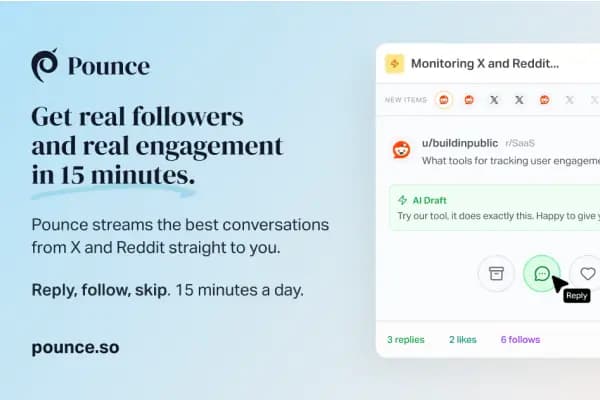
Pounce monitors keywords and subreddits you define, then surfaces the most relevant conversations in a prioritized feed. Instead of scrolling through noise, you see a curated list of threads where your input would actually matter — ranked by engagement potential and relevance to your set topics. For a founder in the developer tools space, this might surface five to eight conversations per day across X and Reddit that are genuinely worth joining.
The AI-generated reply suggestions are better than you'd expect. They're not generic — they analyze your past replies and posts to understand your voice, your areas of expertise, and your typical stance on common topics in your niche. The suggestions come with three variation options (direct, question, or contrarian), and you can edit freely. Most users report using them as a starting point about 60% of the time rather than drafting from scratch.
Setup takes about 20 minutes: connect your X account, define five to ten seed topics, add the subreddits you want to monitor, and optionally connect your past X posts so the AI can calibrate your voice. After the first week, the relevance scoring noticeably improves as it learns which conversations you actually engage with versus skip.
Databuddy: tracking what works
Databuddy sits on the analysis side of the equation — instead of telling you where to engage, it tells you what's working. After the first week of data, it identified that Reddit replies in r/SaaS were generating 4x more profile visits than X replies in equivalent-sized threads. That single insight reshaped the entire strategy: double down on Reddit depth, use X primarily for reach during high-traffic thread moments.
The weekly digest is particularly useful. It doesn't just show you vanity metrics — it correlates engagement activity with downstream outcomes like newsletter signups, product page visits, and GitHub stars (if you're tracking those). This closes the loop between 'I replied to a thread' and 'here's what that actually produced.' Without this feedback loop, you're flying blind, repeating behaviors that feel productive but may not be driving growth.
Finding the right subreddits
One of the most common mistakes in Reddit-based audience building is targeting the wrong subreddits. The instinct is to find the largest relevant community — r/entrepreneur has 3 million members, so it must be worth posting there. But the signal-to-noise ratio in large, general subreddits is terrible. Your contribution is a needle in a haystack, and the audience is too broad to drive meaningful conversion.
The better approach: find mid-sized, high-engagement subreddits that are specific to your target user. For a developer tools product, this might be r/devops (400k members, highly active), r/webdev (800k, focused), or niche communities like r/selfhosted (200k, extremely engaged). The key metric isn't subscriber count — it's comment-to-post ratio and the quality of top comments. A subreddit where 20% of posts have 20+ comments is more valuable than one where 2% of posts get any engagement at all.
- r/SaaS — B2B founders, early-stage product discussions, very reply-friendly
- r/IndieHackers — Solo founders and small teams, high tolerance for sharing revenue numbers
- r/devops — Technical operators and platform engineers, deep technical questions
- r/startups — Broad startup audience, good for early-stage product feedback posts
- r/webdev — Frontend and full-stack developers, tool recommendations welcomed
- r/productivity — Broader audience, good for tools that improve personal workflows
Your specific list will depend on your product category. The process for finding your best subreddits: search Reddit for the problem your product solves, look at which subreddits the most helpful existing posts live in, then check whether those communities have recent posts (last 24 hours) with active comment threads. Add the top three to five to Pounce and monitor for two weeks before making changes.
What makes a reply worth reading
This is the skill that determines whether your engagement efforts compound into real audience growth. The reply that works isn't the one that promotes your product — it's the one that makes the original poster and other readers think 'this person really knows their stuff.' There's a simple framework: add a data point, a concrete example, or a counterpoint with evidence. Any one of those makes a reply worth reading. None of them require you to mention what you're building.
On X, your best replies are typically two to four sentences: one sentence acknowledging the original point, one sentence adding your angle, and optionally one sentence that opens a thread for further conversation. Resist the urge to over-explain. The goal of the reply is not to give a complete answer — it's to make the reader curious enough to click your profile.
On Reddit, longer is often better — the platform rewards thoroughness. A 300-500 word reply that actually addresses the question from multiple angles will be upvoted and referenced far more than a quick take. Structure matters: use line breaks, bullet points, and headers for longer answers. Reddit's markdown support is full — use it. A visually organized long-form answer reads as expertise; a wall of text reads as effort without skill.
“Audience growth isn't about being everywhere. It's about being consistently the most useful voice in a specific set of conversations.”
— Tama
Your 15-minute daily routine
The routine only works if it's consistent. Irregular bursts of engagement followed by silent periods signal inauthenticity to algorithms and audiences alike. Set the same 15-minute window every day — either before your first meeting or after lunch — and treat it as non-negotiable. Most people who fail at this routine fail because they try to do it 'when they have time,' which means it almost never happens.
- 1Open Pounce — review the top 5 conversations flagged for your niche (2 min)
- 2Leave 2 thoughtful replies on X threads — prioritize threads under 2 hours old (5 min)
- 3Leave 1 detailed answer on the highest-upvote Reddit post from Pounce's feed (5 min)
- 4Check Databuddy for yesterday's metrics — note one thing to double down on (3 min)
The discipline is step four. Most people skip the measurement step because nothing feels urgent about it. But the feedback loop is what separates a growth system from random activity. After two weeks, Databuddy will surface patterns you'd never notice manually — which thread topics drive the most follows, which subreddits convert best to product visits, which reply styles generate follow-on conversations versus silent upvotes.
One practical tip: prepare your context before the 15-minute window starts. Have three or four data points, opinions, or examples from your domain loaded in a notes doc that you can reference quickly when drafting replies. This prevents you from spending your 15 minutes thinking instead of writing. The mental preparation happens outside the window; the execution happens inside it.
Advanced: stacking X and Reddit
Once you're comfortable with the basic routine, there's a compounding strategy that most people don't use: cross-platform content stacking. When you write a detailed Reddit answer that performs well — say it gets 50+ upvotes and multiple replies — that content has already been validated as valuable. Turn it into an X thread. The same insight that resonated with a technical Reddit audience will often perform just as well reformatted as a numbered thread on X.
The reverse also works: when you write an X thread that gets significant engagement, find the relevant subreddit and post the core insight there as a question or discussion prompt. Don't paste the thread verbatim — Reddit audiences respond poorly to obvious cross-posting. Instead, use the validated insight to frame a genuine question or 'unpopular opinion' post. This creates two pieces of platform-native content from a single insight.
The stacking effect becomes significant at the 90-day mark. By that point, you have a library of validated insights and reply patterns. You know which topics your audience responds to, which subreddits are worth your time, and which X accounts to engage with for maximum reach. The AI tools augment this compounding knowledge — Pounce's relevance scoring gets better, Databuddy's correlation models get sharper, and your engagement rate climbs without increasing your time investment.
Common mistakes to avoid
- Promoting your product in replies before building credibility — this destroys trust and gets you flagged as spam on Reddit
- Replying to threads that are too old — replies on X threads older than 6 hours rarely get seen; Reddit is more forgiving but still rewards recency
- Inconsistent posting patterns — algorithm momentum requires daily presence, even if some days are lighter than others
- Using AI-generated replies verbatim without editing — they read as AI to experienced community members and undermine your credibility
- Tracking only vanity metrics (likes, upvotes) instead of conversion metrics (profile visits, newsletter signups, product page traffic)
- Spreading across too many platforms too early — X and Reddit first, everything else second
The hardest mistake to avoid is premature product promotion. It feels counterintuitive to spend two weeks building reputation without mentioning what you're building. But Reddit communities in particular have long memories and low tolerance for promotional behavior. A single reply that reads as a pitch will undo weeks of credibility building. The rule: only mention your product when someone directly asks what you're working on, or when it's the single most relevant answer to someone's specific question.
Results after 30 days
We tested this exact routine with three founders across different niches over 30 days. One in B2B developer tools, one in a consumer productivity app, and one in a bootstrapped SaaS targeting small agencies. The routine was identical — 15 minutes daily, Pounce for discovery, Databuddy for measurement.
Average results across the three: 847 new X followers, 312 net-new Reddit karma (across the two or three subreddits each was targeting), and 23 inbound conversations that led directly to product signups or sales conversations. The developer tools founder saw the most Reddit leverage; the consumer app founder saw the most X leverage. The SaaS founder saw roughly equal contribution from both platforms — which Databuddy surfaced at the end of week two, prompting him to adjust his time allocation.
These aren't viral numbers. You won't hit 10,000 followers in a month. But the quality of the audience built through this method is measurably higher than growth from traditional content marketing: higher reply rates, higher email open rates for product updates, and a higher conversion rate from follower to paid customer. Sustainable, compounding growth that costs nothing but 15 minutes a day. If you're looking for the broader toolkit to support this growth, browse our curated collection of growth tools for founders — you'll find complementary tools for email capture, landing page optimization, and beyond.