A conversational AI chatbot is a chat program that reads what you type in your own words and writes a reply, instead of walking you through fixed menus. Two very different products share the name: the AI chat apps you use yourself, such as ChatGPT, Claude and Gemini, and the platforms a business uses to put an AI agent on its website or help desk.
This guide explains what the term means, then compares 14 options from their own pricing pages, checked on 20 October 2026: six general AI chat apps and eight chatbot platforms for business, plus four third-party chatbot apps that come up in the same searches. listing.sh did not run test conversations with these products, so there are no scores or rankings. Each entry lists what the product does, what it costs in US dollars where the vendor shows it, and what to check before you pay.
What is a conversational AI chatbot?
IBM splits chatbots into two groups. "Traditional chatbots, also called rule-based chatbots, follow predefined rules, decision trees or scripted responses." AI chatbots instead "use AI models to interpret natural language, maintain context and generate responses" (IBM (opens in a new tab)).
Conversational AI is the technology behind the second group. IBM describes it as systems that "use large volumes of data, machine learning and natural language processing to help imitate human interactions" (IBM (opens in a new tab)). The model reads the meaning of the message (natural language understanding), keeps track of what was said earlier, and writes a new reply (natural language generation). As IBM puts it, "every AI chatbot is a chatbot, but not every chatbot is an AI chatbot".
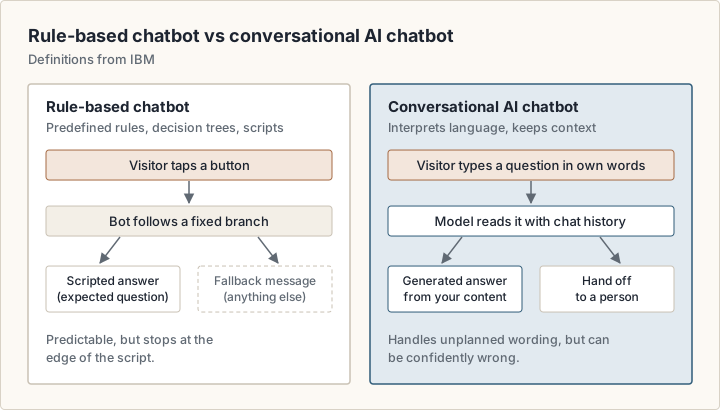
In practice the difference shows up at the edges. A rule-based bot handles the questions its designer expected and stops at a fallback message for anything else. A conversational AI chatbot can answer a question phrased in a way nobody planned for, but it can also answer confidently and wrongly. That trade-off shapes how you choose one, and most business platforms below combine both: scripted flows for steps such as refunds, and an AI agent for open questions.
Chat apps, chatbot apps and chatbot platforms
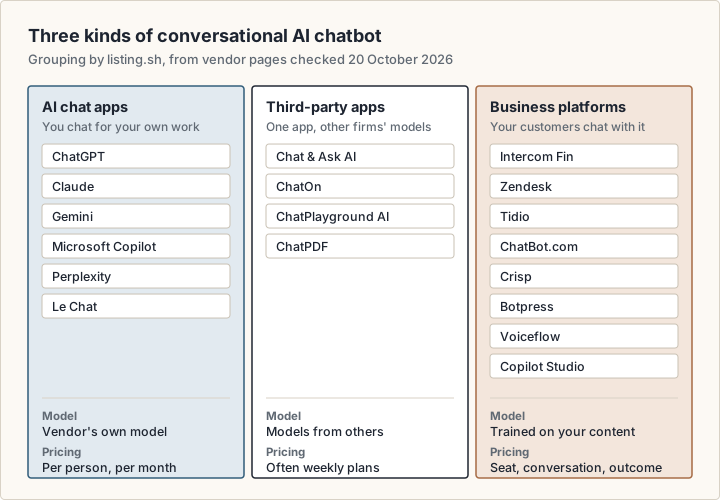
Search results for this topic mix three kinds of product. Telling them apart answers most of the "which one" question before you compare prices.
- General AI chat apps, sometimes called AI chat platforms: ChatGPT, Claude, Gemini, Microsoft Copilot, Perplexity and Le Chat. The vendor builds the model and the app, and you chat with it for your own work.
- Third-party chatbot apps: mobile apps such as Chat & Ask AI and ChatOn that run on models from other companies and sell their own subscription.
- Chatbot platforms for business: Intercom Fin, Zendesk, Tidio, ChatBot.com, Crisp, Botpress, Voiceflow and Microsoft Copilot Studio. You connect your help articles and policies, and the AI agent answers your customers on your site or in your help desk.
A GPT chatbot, another common search, usually means one of two things: ChatGPT itself, or a business chatbot built on a GPT model. Several platforms below let you pick the underlying model, so the brand on the chat window does not always tell you which model writes the answer.
AI chat platform options compared
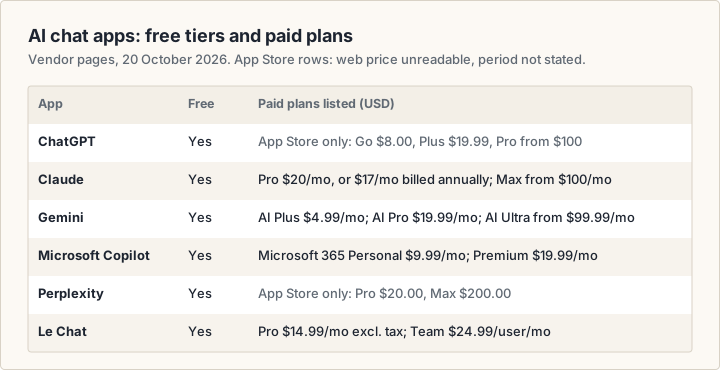
These are the apps you use yourself. Each has a free tier, so you can try the conversation style before you pay. Prices are in US dollars as of October 2026, exclude tax unless stated, and change often, so check the linked page before you buy. OpenAI's and Perplexity's pricing pages blocked our automated check, so for those two we list what the US App Store shows and send you to the vendor page for current web prices.
ChatGPT
OpenAI's assistant. The app description says the official app is free and covers real-time voice conversations and image generation from a description. The US App Store lists in-app purchases for ChatGPT Go ($8.00), ChatGPT Plus ($19.99) and ChatGPT Pro tiers from $100.00, without stating the billing period (App Store: ChatGPT (opens in a new tab)). For web prices and what each plan includes, check the ChatGPT pricing page (opens in a new tab).
Claude
Anthropic's assistant. The free plan includes web search, file creation, code execution, memory and Artifacts, with Sonnet and Haiku models and up to five Projects (Claude pricing (opens in a new tab)). Pro costs $20 a month billed monthly or $17 a month on an annual plan ($200 billed up front), and adds Claude Code, Opus and more models; the FAQ puts Pro at least five times Free usage per five-hour session. Max starts at $100 a month for five times Pro usage, with a 20x tier as well. Team seats cost $25 a month billed monthly or $20 billed annually. Our guide to agent skills covers one way teams extend it.
Gemini
Google's assistant. The free plan uses the Flash-Lite model and includes Deep Research, Gemini Live and Canvas (Gemini plans (opens in a new tab)). Google AI Plus costs $4.99 a month with twice the free usage limits, Google AI Pro $19.99 with four times, and Google AI Ultra $99.99 or $199.99 a month for five or twenty times the AI Pro limits. Paid plans bundle Google cloud storage: 400 GB on Plus. Google says limits depend on prompt complexity, features and chat length, and refresh every five hours until you reach a weekly limit.
Microsoft Copilot
Microsoft's assistant. Its paid plans list "higher usage than free", and Microsoft 365 Premium has a one-month free trial (Microsoft Copilot (opens in a new tab)). Copilot comes with Microsoft 365: Personal at $9.99 a month or $99.99 a year, Family at $12.99 or $129.99, and Premium at $19.99 or $199.99. Paid plans add Copilot in Word, Excel, PowerPoint and Outlook. On Family, Microsoft says the AI features are "currently available only to the subscription owner", not all six people.
Perplexity
An answer engine rather than a pure chatbot. The app is free, and its App Store description promises "cited sources for every answer" and says it uses models from OpenAI, Anthropic, Meta and others. The US App Store lists Perplexity Pro at $20.00 and $200.00 and Perplexity Max at $200.00, without stating the billing period (App Store: Perplexity (opens in a new tab)). Check the Perplexity Pro page (opens in a new tab) for web prices.
Le Chat (Mistral)
Mistral's assistant. The free plan has "limited messages and web searches" (Mistral pricing (opens in a new tab)). Pro costs $14.99 a month excluding taxes and includes $15 a month in API credits; verified students pay $5.99 a month for up to 12 months. Team costs $24.99 per user a month, with up to 30 GB of storage per user.
Third-party chatbot apps: ChatOn, Chat & Ask AI, ChatPlayground and ChatPDF
Several popular chatbot apps do not build their own models. They put other companies' models behind one app and sell access by subscription. That can be convenient, but read the plan length before you tap subscribe.
- Chat & Ask AI: the App Store listing says it is "built on" models including GPT, Claude, Gemini, Grok, DeepSeek and Perplexity, and lets you pick one per task. The seller is Deep Flow Software Services, with a Codeway copyright line. In-app purchases include one-week Premium plans from $7.39 to $11.99 and lifetime plans (App Store: Chat & Ask AI (opens in a new tab)).
- ChatOn: from AIBY, "built on GPT-5, Gemini 3.5, Claude Sonnet 5, and Sonar" according to its listing. It summarises PDFs and YouTube videos. In-app purchases include one-week plans at $6.99 and $7.99 and a one-year plan at $59.99 (App Store: ChatOn (opens in a new tab)).
- ChatPlayground AI: a web app for comparing models. Compare Mode sends one prompt to several models and shows each answer side by side; the page names ChatGPT, Claude, Gemini, Perplexity, DeepSeek and Grok, and quotes a $20 a month subscription (ChatPlayground AI (opens in a new tab)).
- ChatPDF: a tool for chatting with documents. Answers carry "clickable citations" that scroll to the source in your PDF, and the free plan analyses two documents a day (ChatPDF (opens in a new tab)). If you already pay for a general assistant, check whether it accepts PDF uploads before you add another subscription.
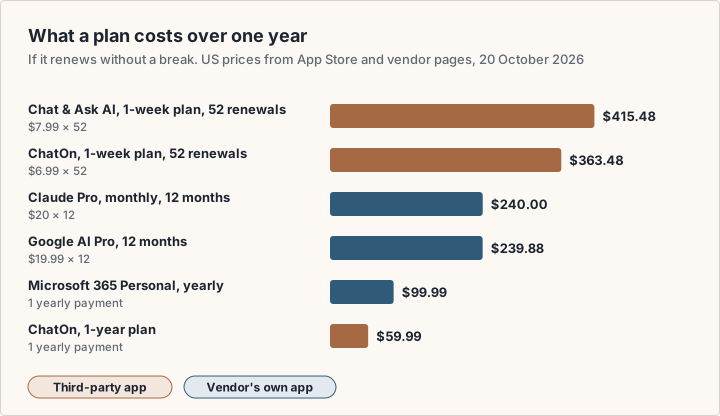
The arithmetic is simple and easy to miss on a phone. A one-week plan at $7.99 that renews every week costs $415.48 over 52 weeks, against $240 for 12 months of Claude Pro at the monthly price. A weekly plan makes sense for a short burst of use; for steady use, compare the yearly total.
Chatbot platforms for your business compared
A business chatbot answers your customers, so the questions change: what it learns from, when it hands off to a person, and how the price grows with volume. Most of these platforms build an AI-powered chatbot from content you already have. ChatBot.com, for example, lets you feed the agent "help articles, internal docs, URLs, and PDFs" (ChatBot.com pricing (opens in a new tab)).
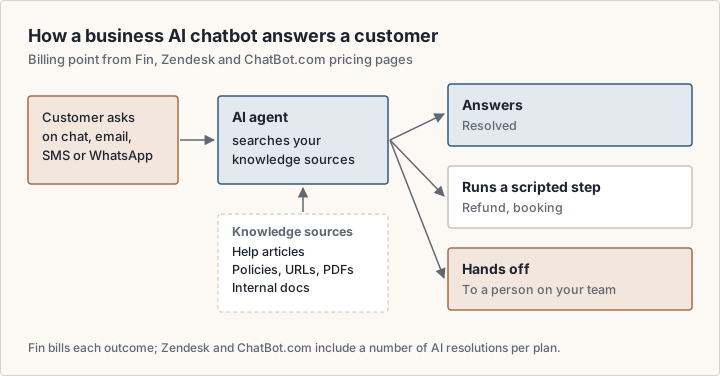
Pricing models differ more than features. Some vendors charge per resolved conversation, some per seat, some per conversation and some per workspace with AI credits. Prices below are in US dollars as of October 2026 unless noted.
Intercom Fin
Fin is Intercom's AI agent, and it also works with other help desks, including Salesforce, HubSpot, Freshworks, Front, Zoho and Gorgias (Fin pricing (opens in a new tab)). It costs $0.99 per outcome, such as a resolution or a handoff, with a 50-outcome monthly minimum on the any-helpdesk plan. On Intercom's own help desk, seats add $29 per seat a month. Fin answers on live chat, email, SMS, WhatsApp and social channels, and the trial runs 14 days without a credit card. See the Intercom tool page for the wider product.
Zendesk
Zendesk says AI agents are "included in every Suite and Support plan" (Zendesk pricing (opens in a new tab)). Suite Team costs $55 per agent a month billed yearly or $69 monthly, with 5 automated resolutions per agent a month. Suite Professional costs $115 or $149, with 10. Extra automated resolutions are listed at $1.50 committed or $2.00 pay-as-you-go.
Tidio
Tidio's AI agent is called Lyro (Tidio pricing (opens in a new tab)). The free plan covers 50 billable conversations, and your first 50 Lyro conversations are free for life. Starter is listed at $24.17 a month and Growth from $49.17 a month. The Lyro AI Agent add-on starts at $32.50 a month for 50 Lyro conversations, and Plus starts at $300 a month. Growth's conversation limit is stated two ways on the page, so confirm it in the calculator.
ChatBot.com
ChatBot.com prices per user (ChatBot.com pricing (opens in a new tab)). Essential costs $19 a user a month billed yearly or $25 monthly, with one AI agent and 10 AI resolutions a month. Growth costs $79 or $99, with 10 AI agents and 200 AI resolutions a month. There is a 14-day trial without a credit card, and the FAQ says there is no permanent free tier.
Crisp
Crisp prices per workspace rather than per seat, and advertises unlimited conversations (Crisp pricing (opens in a new tab)). AI credits cap the automated ones. Mini costs $45 a month with $5 in AI credits, about 90 automated conversations; Essentials $95 with $25, about 450; Plus $295 with $75, about 1,350. The free plan has no AI credits, and VAT is not included. The page shows $ without a currency code. More on the Crisp tool page.
Botpress
Botpress is a builder for custom AI agents (Botpress pricing (opens in a new tab)). The free plan includes 100 conversations, three seats and three agents. Plus costs $150 a month billed annually for 250 conversations and $25 of AI usage; Team costs $750 a month billed annually for 1,500 conversations. Extra conversations come in packs of 100, and the page says each conversation includes $0.10 of AI usage "covered by us".
Voiceflow
Voiceflow builds voice and chat agents. Its pricing page shows no public prices: agencies get a free trial with "usage-based billing", and businesses are asked to request pricing (Voiceflow pricing (opens in a new tab)). Budget time for a sales call.
Microsoft Copilot Studio
Copilot Studio is Microsoft's tool for building your own agents. A capacity pack costs $200 a month for 25,000 Copilot Credits; pay-as-you-go billing runs through an Azure subscription (Copilot Studio pricing (opens in a new tab)). The page says all billing options share the same features. How many credits a conversation uses depends on what the agent does, so estimate your usage before you commit.
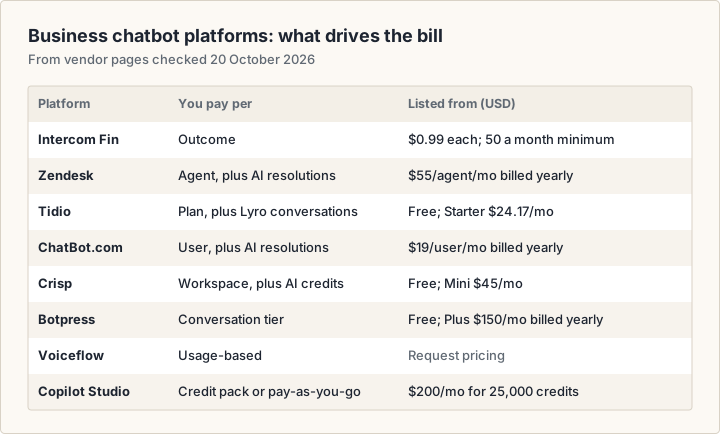
The billing unit matters more than the headline price. With per-outcome pricing, the cost follows the share of questions the AI resolves. With per-seat pricing, the cost follows your team size, and the included AI resolutions can run out quickly. Before you compare totals, estimate your monthly chat volume and the share you expect the AI to handle.
How to choose a conversational AI chatbot
No ranking settles this, because the right choice depends on who will chat with it and what it needs to know. Start with the kind of product, then work through these questions.
- 1Who is chatting: you, or your customers? For your own work, compare the AI chat apps. For customers, compare the business platforms.
- 2What must it know? A personal assistant works from the web and your uploads. A support bot needs your help articles and policies, and someone to keep them current.
- 3What happens when it is wrong? Check how each platform hands off to a person, and whether it can run scripted steps for refunds or bookings.
- 4What is the billing unit? Per outcome, per seat, per conversation or per credit. Model a quiet month and a busy one.
- 5What are the limits on the free tier? Message caps, model choice and usage windows differ, and several apps reset limits every few hours.
- 6How long is the plan? Weekly app subscriptions cost far more over a year than monthly or yearly plans.
- 7Where does the data go? Read the privacy terms before you paste customer or company data.
If you want to compare answers before you choose, try the same three or four real questions in two or three free tiers. If you build on the AI, our guides to building software with AI and AI website builders cover the next steps.
What not to tell an AI chatbot
Treat a chatbot conversation like an email to a stranger at the vendor. Google's Gemini privacy notice says "human reviewers (including trained reviewers from our service providers) review some of the data we collect", and asks: "Please don't enter confidential information that you wouldn't want a reviewer to see." Reviewed chats are kept for up to three years (Gemini Apps Privacy Hub (opens in a new tab)). Other vendors have their own terms; read them before you share.
- Passwords, API keys, card numbers or one-time codes.
- Customer personal data, unless your contract with the vendor covers it.
- Unreleased company plans, source code you may not share, or anything under a confidentiality agreement.
- Health, legal or money questions where a wrong answer has real cost. Use the answer as a starting point, and ask a qualified professional.
Frequently asked questions
What is the difference between a chatbot and conversational AI?
A chatbot is any program you chat with. Conversational AI is the technology that lets it understand free text and write new replies. A rule-based chatbot follows a script; an AI chatbot uses a model (IBM (opens in a new tab)).
Which conversational AI chatbot is best?
It depends on the job, so this guide does not rank them. For personal use, try the free tiers of two or three AI chat apps on your own questions. For customer support, compare how each platform bills: per outcome, per seat or per conversation.
Is there a free AI chatbot app?
Yes. ChatGPT, Claude, Gemini, Microsoft Copilot, Perplexity and Le Chat all offer free use with limits. Among business platforms, Tidio, Crisp and Botpress list free plans; Crisp's free plan has no AI credits.
What is a GPT chatbot?
Usually ChatGPT, or a chatbot built on one of OpenAI's GPT models. Third-party apps such as ChatOn say they are built on GPT models alongside others, so check the listing to see which models an app uses.
Can an AI chatbot read PDFs?
Yes. ChatPDF is built for it and links each answer to the source in your PDF (ChatPDF (opens in a new tab)). Business platforms such as ChatBot.com can also learn from PDFs you upload, so the bot answers customers from your documents.
Sources
- IBM: What is a chatbot? (opens in a new tab)
- IBM: What is conversational AI? (opens in a new tab)
- OpenAI: ChatGPT pricing (opens in a new tab)
- App Store (US): ChatGPT (opens in a new tab)
- Anthropic: Claude pricing (opens in a new tab)
- Google: Gemini subscriptions (US) (opens in a new tab)
- Google: Gemini Apps Privacy Hub (opens in a new tab)
- Microsoft: Copilot for individuals (opens in a new tab)
- Microsoft: Copilot Studio pricing (opens in a new tab)
- Perplexity: Pro (opens in a new tab)
- App Store (US): Perplexity (opens in a new tab)
- Mistral AI: pricing (opens in a new tab)
- App Store (US): Chat & Ask AI (opens in a new tab)
- App Store (US): ChatOn (opens in a new tab)
- ChatPlayground AI (opens in a new tab)
- ChatPDF (opens in a new tab)
- Fin: pricing (opens in a new tab)
- Zendesk: pricing (opens in a new tab)
- Tidio: pricing (opens in a new tab)
- ChatBot.com: pricing (opens in a new tab)
- Crisp: pricing (opens in a new tab)
- Botpress: pricing (opens in a new tab)
- Voiceflow: pricing (opens in a new tab)